
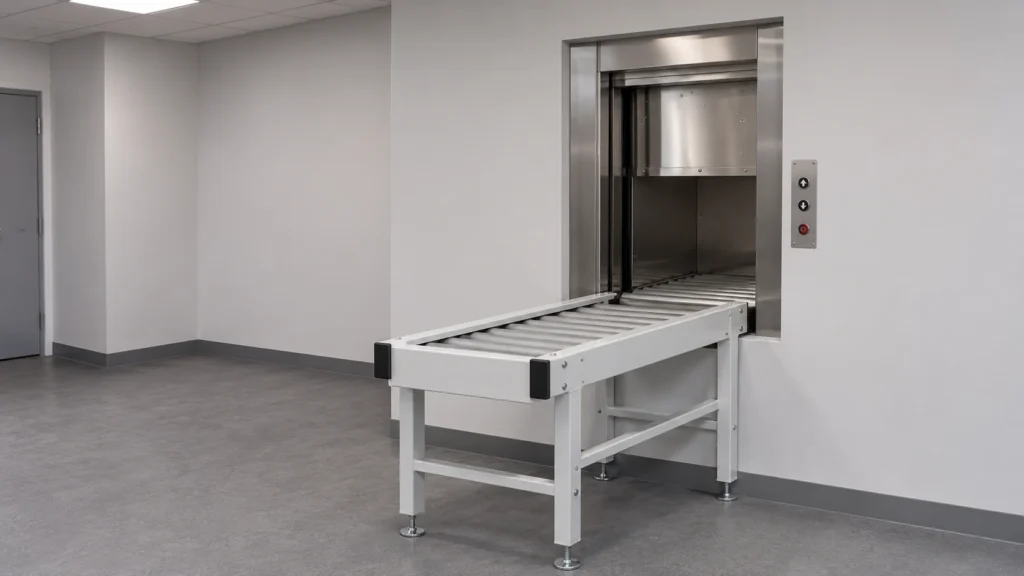

A document lift is a small goods-only service lift used to move files, books, post and other suitable items between floors. Its main benefit is reducing repeated carrying on stairs where physical records and materials regularly move between departments or storage areas.
The term describes an application of a dumbwaiter or service lift, rather than a separate document-management system. A document lift transports the load; staff remain responsible for organising, recording and collecting it.
For offices, libraries and archives, the right installation depends on what needs to move, how often it moves and how it will be loaded.
What can a document lift carry?
A suitably specified document lift can transport items such as:
- Files, folders and bound records.
- Books and journals.
- Internal post and stationery.
- Document trays and suitable storage boxes.
- Small office supplies within its intended use.
The load must fit inside the car, remain stable during travel and stay within the lift’s rated capacity. A box of paper or books can be heavier than its size suggests, so capacity should be based on actual loaded weights.
Document lifts carry goods only. People must never travel inside them.
What are the benefits of a document lift?
Less carrying between floors
Moving individual files may be straightforward, but repeated journeys with books, archive boxes or bundles of post can become an awkward handling task.
A document lift can remove the stair-carrying stage from that journey. However, loading and unloading still need consideration: a poorly positioned entrance may leave staff bending, reaching or lifting unnecessarily.
HSE’s manual-handling guidance explains the importance of avoiding hazardous handling where reasonably practicable, assessing unavoidable tasks and reducing the remaining risks. A lift can form part of that approach when it suits the task.
Fewer interruptions to everyday work
Where physical materials regularly move between floors, a dedicated lift can reduce the need for staff to leave their working area to carry them.
For example, an archive team could send requested files to a collection point on another floor. The receiving team would collect them without someone making the full journey with the load.
The benefit depends on having a clear process. Staff need to know what has been sent, where it is going and who will collect it.
A practical connection to storage areas
Some organisations keep records or book stock away from their main working floor. A service lift can connect those areas, provided the proposed route and landing positions are suitable.
This may be useful in a library with storage on another level, an office with a separate records room or an archive where materials frequently move to a consultation area.
Husbands’ commercial dumbwaiters and service lifts can be assessed against the dimensions, weight and frequency of these loads.
Where are document lifts useful?
A document lift is most relevant where there is a recurring need to move physical materials vertically.
| Setting | Possible application | Main consideration |
|---|---|---|
| Offices | Files, internal post and stationery between departments | Frequency of journeys and convenient collection points |
| Libraries | Books between storage and staff processing areas | Loaded weight, shelving and handling method |
| Archives | Boxed records between storage and consultation areas | Box dimensions, stability and collection procedures |
| Professional practices | Physical case files between working floors | Confidentiality and controlled handover |
A lift may offer little benefit where most records are digital and physical transfers are infrequent. It is worth observing the existing task before committing space and budget to an installation.
How do you choose the right document lift?
Start with the load and its journey, rather than selecting a lift by capacity alone.
Measure the items being transported
Record the dimensions of the largest box, tray or container. Check that it will pass through the landing opening and fit inside the usable car space.
If several items need to travel together, assess the full load arrangement, including any shelves.
Establish the loaded weight
Include the contents and the container. The lift’s rated capacity must accommodate the intended load, but that does not mean staff should manually lift an equally heavy box into it.
Consider the loading method
Counter-height access may suit trays and smaller bundles. Larger quantities arriving on a wheeled cart may be better served by a floor-loading trolley lift, avoiding the need to transfer everything by hand.
Assess the building and peak demand
The specification also needs to consider the number of floors, available shaft space, headroom, power supply and maintenance access.
Think about busy periods as well as average use. Several departments sharing one lift may need agreed priorities and prompt collection to prevent delays.
Can a document lift track or secure confidential files?
A standard document lift moves physical items. It does not automatically identify files, record their location or update a document-management database.
If tracking is needed, the organisation must establish a separate process, such as logging dispatch and receipt. Any proposed connection to software would require specific technical assessment.
Confidentiality also needs planning. Landing locations, access arrangements and collection procedures should prevent sensitive records being left unattended or collected by the wrong person. A lift should not be assumed to provide secure document storage.
Do document lifts need maintenance?
Yes. Regular servicing is needed even where loads are relatively light. Doors, interlocks, controls and lifting components must remain in suitable working condition.
Maintenance should reflect the manufacturer’s instructions, installation conditions and frequency of use. Workplace thorough-examination requirements also need to be addressed separately from routine servicing.
Husbands provides service lift maintenance and repairs to support ongoing reliability.
Is a document lift right for your workplace?
A document lift is worth considering when staff repeatedly carry files, books or supplies between floors and there is a suitable route connecting the relevant areas.
The strongest case comes from a clearly identified task: what moves, how much it weighs, how frequently it travels and who receives it. That information helps establish whether a compact service lift, trolley lift or another arrangement would be most practical.
Contact Husbands to discuss your building and handling requirements. The team can help assess the available space and suitable lift options.