
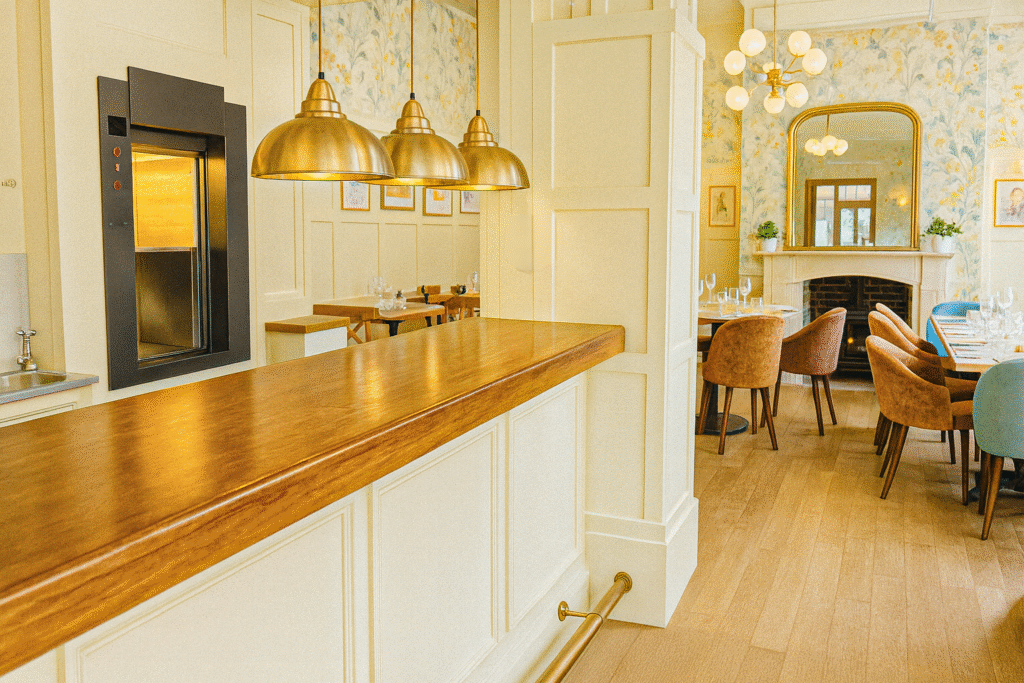

Short answer: Yes. In the UK, a dumbwaiter is classed as lifting equipment, so it falls under the Lifting Operations and Lifting Equipment Regulations 1998 (LOLER). If it’s used in a workplace, it must be thoroughly examined by a competent person at intervals of no more than six months. Think of it like an MOT for your lift: a periodic check, required by law, that confirms the equipment is safe to keep using.
The rest of this guide explains exactly what that means in practice: what the law asks of you, who carries the responsibility, how a thorough examination differs from routine servicing, and where the separate construction standard (BS EN 81-3) fits in. It’s written for the people who actually have to make the decision, such as facilities managers, restaurant and hotel operators, building owners, and specifiers.
First, a quick word on terminology
“Service lift” is an umbrella term, and it’s worth being clear about it up front because people use these words differently. A service lift is any lift designed to move goods rather than people between floors — and that family includes dumbwaiters (the compact food and goods lifts common in restaurants, hotels and homes), trolley lifts (for wheeled loads), and goods lifts (for heavier items). They differ in size and capacity, but in the eyes of the law they share the same status: all are lifting equipment, and all fall under LOLER.
So whether your lift is a dumbwaiter, a trolley lift or a goods lift, the safety and inspection duties in this guide apply to it. We use “dumbwaiter” throughout as the most common example, but everything here holds for service lifts generally.
Why dumbwaiters fall under LOLER
LOLER 1998 is the legal framework governing the safe installation, maintenance and inspection of lifting equipment across Great Britain. Because a dumbwaiter raises and lowers loads between floors, it is lifting equipment in the eyes of the law, and that brings it squarely within LOLER’s scope, the same way a passenger lift or a goods hoist would be.
The regulations exist for two reasons: legal compliance, and the safety of anyone operating the lift or working nearby. They sit alongside the Health and Safety at Work Act, which places a broader duty on employers to keep equipment safe. Together they mean that owning a workplace dumbwaiter isn’t a “fit and forget” decision, there’s an ongoing legal duty attached to it.
A reasonable question is whether this applies to a dumbwaiter in a private home. LOLER applies to equipment used at work. A purely domestic dumbwaiter in a private residence, used only by the household, generally sits outside LOLER, but the moment a lift is used in a business context (a B&B, a home that employs staff, a holiday let), the workplace duties can apply. If you’re unsure which side of the line you’re on, treat it as in scope and get advice; the cost of a check is trivial next to the cost of getting it wrong.
What LOLER actually requires of you
Stripped of the legal language, LOLER places a handful of clear duties on whoever is responsible for the lift:
- Arrange a thorough examination at least every six months. For most dumbwaiters carrying goods, the maximum interval is six months. The examination must be carried out by a competent person — someone with the knowledge and independence to assess the lift properly, typically a qualified lift engineer or inspection body.
- Keep the equipment properly maintained between examinations, so it stays in safe working order.
- Keep records. The competent person issues a written report of thorough examination. You need to keep these, act on anything they flag, and be able to produce them if asked.
- Act on defects. If an examination identifies a fault that could become a danger, you must address it within the timescale the report specifies.
Who is the “responsible person”?
This is the question that catches people out. The duty holder is usually the employer or whoever has control of the premises where the lift operates — not the manufacturer, and not the engineer who installed it. If you own or run the building and the dumbwaiter is used for work, the responsibility to arrange examinations is almost certainly yours. You can (and should) contract the actual inspection out to a competent person, but you can’t contract away the legal duty to make sure it happens.
Servicing vs. thorough examination: not the same thing
A common and costly misunderstanding is treating a routine service as if it satisfies LOLER. It doesn’t. The two are different jobs:
- Routine servicing/maintenance keeps the lift running well — lubrication, adjusting door mechanisms, cleaning electrical components, replacing worn parts. It’s preventative, and you’d typically schedule it around every six months. It keeps the equipment reliable.
- A thorough examination is the statutory check required by LOLER. It’s a systematic, independent assessment of the lift’s mechanics, safety features and structural integrity by a competent person, resulting in a formal report. It’s about proving the lift is safe, not just keeping it running.
You need both. Good maintenance reduces the chance an examination turns up a serious defect, but it never replaces the examination itself. Many owners arrange them together under a single maintenance-and-inspection contract, which is the simplest way to stay compliant without tracking two separate schedules.
For a fuller breakdown of what good year-round upkeep looks like, see our guide to dumbwaiter maintenance schedules.
Using your dumbwaiter safely day to day
Compliance isn’t only about the six-monthly check. Sensible everyday use keeps the lift safe and reduces wear between examinations:
- Never exceed the rated load (for service lifts under BS EN 81-3, that’s a maximum of 300 kg).
- Load evenly and don’t let items protrude beyond the car.
- Keep landing doors and interlocks clear and working; report anything that sticks, grinds, judders or makes unusual noise.
- Make sure staff know the basics of safe operation and who to tell when something seems off.
Catching small issues early is exactly what prevents them escalating into expensive breakdowns, or into a defect that fails your next examination.
Where BS EN 81-3 fits in (and why it’s not the same as LOLER)
Here’s the distinction that trips most people up. LOLER governs the lift while it’s in service. BS EN 81-3 governs how it’s built and installed in the first place. They’re complementary, not interchangeable.
BS EN 81-3:2001 is the European standard setting out safety rules for the construction and installation of electric and hydraulic service lifts, commonly called dumbwaiters in restaurant and domestic settings. It applies to permanently installed service lifts with a rated load not exceeding 300 kg that are designed to carry goods, not people. It’s the successor to the older British Standard BS 5655-3:1989, updated to reflect modern lift design and safety expectations.
In practical terms, the standard covers:
- Mechanical and electrical components — quality and safety requirements for the parts that make the lift work.
- Materials and construction — requiring durable, reliable materials fit for daily use.
- Installation — detailed procedures for installing the lift safely and correctly.
- Safety devices and features — the mandatory protections that prevent accidents.
- Inspection and testing before use — the checks a new lift must pass before it enters service.
So when you buy a new dumbwaiter, BS EN 81-3 is what assures you it’s been built and installed to a recognised safety standard. Once it’s in and working, LOLER is what keeps it safe over its working life. A well-specified lift meets both: built to EN 81-3, examined under LOLER.
What happens if you don’t comply
LOLER is a legal requirement, not best-practice guidance. Failing to arrange thorough examinations or ignoring defects flagged in a report exposes you to real consequences:
- Enforcement and penalties. Non-compliance with health and safety law can lead to enforcement action, fines and, in serious cases, prosecution.
- Insurance and liability. If an incident occurs and the lift wasn’t compliant, your insurance position and personal/organisational liability can be severely affected.
- Operational risk. Beyond the legal angle, an unexamined lift is more likely to fail unexpectedly — and in hospitality, healthcare or retail, downtime and safety incidents carry their own heavy costs.
A six-monthly examination from a competent provider is a routine, low-cost commitment that keeps you on the right side of the law and your equipment running reliably.
Commercial settings: where this matters most
In commercial environments such as restaurants, hotels, hospitals, care homes, and retail, dumbwaiters often run many cycles a day, every day. That intensity makes both regular maintenance and on-schedule LOLER examinations more important, not less: wear accumulates faster, and a failure disrupts service immediately. If you operate a workplace lift, building the six-monthly examination into a planned maintenance contract is the most reliable way to stay compliant and avoid unplanned downtime.
Frequently asked questions
Do dumbwaiters legally need LOLER inspections in the UK? Yes. A dumbwaiter is lifting equipment, so a workplace dumbwaiter must be thoroughly examined under LOLER 1998 by a competent person at least every six months.
How often does a dumbwaiter need to be inspected? At intervals of no more than six months for the LOLER thorough examination. Routine servicing is usually scheduled on a similar cycle, and the two are often combined.
Who can carry out a LOLER inspection on a dumbwaiter? A “competent person” — someone with the training, experience and independence to assess the lift properly, typically a qualified lift engineer or accredited inspection body. The legal duty to arrange it sits with the building owner or employer.
Is a service the same as a LOLER thorough examination? No. Servicing keeps the lift running; a thorough examination is the statutory safety check required by law, carried out independently and recorded in a formal report. You need both.
What’s the difference between LOLER and BS EN 81-3? BS EN 81-3 is the construction-and-installation standard for new service lifts (how the lift is built). LOLER is the in-service inspection regime (how it’s kept safe once installed). A compliant dumbwaiter satisfies both.
Does LOLER apply to a dumbwaiter in a private home? LOLER applies to equipment used at work. A purely domestic, household-only dumbwaiter generally falls outside it — but any business use (B&Bs, premises with staff, holiday lets) can bring workplace duties into play. If in doubt, get advice.
Need your dumbwaiter examined or serviced? Husbands provides expert dumbwaiter and service-lift maintenance and LOLER compliance checks across the UK. Arrange an inspection or service today.